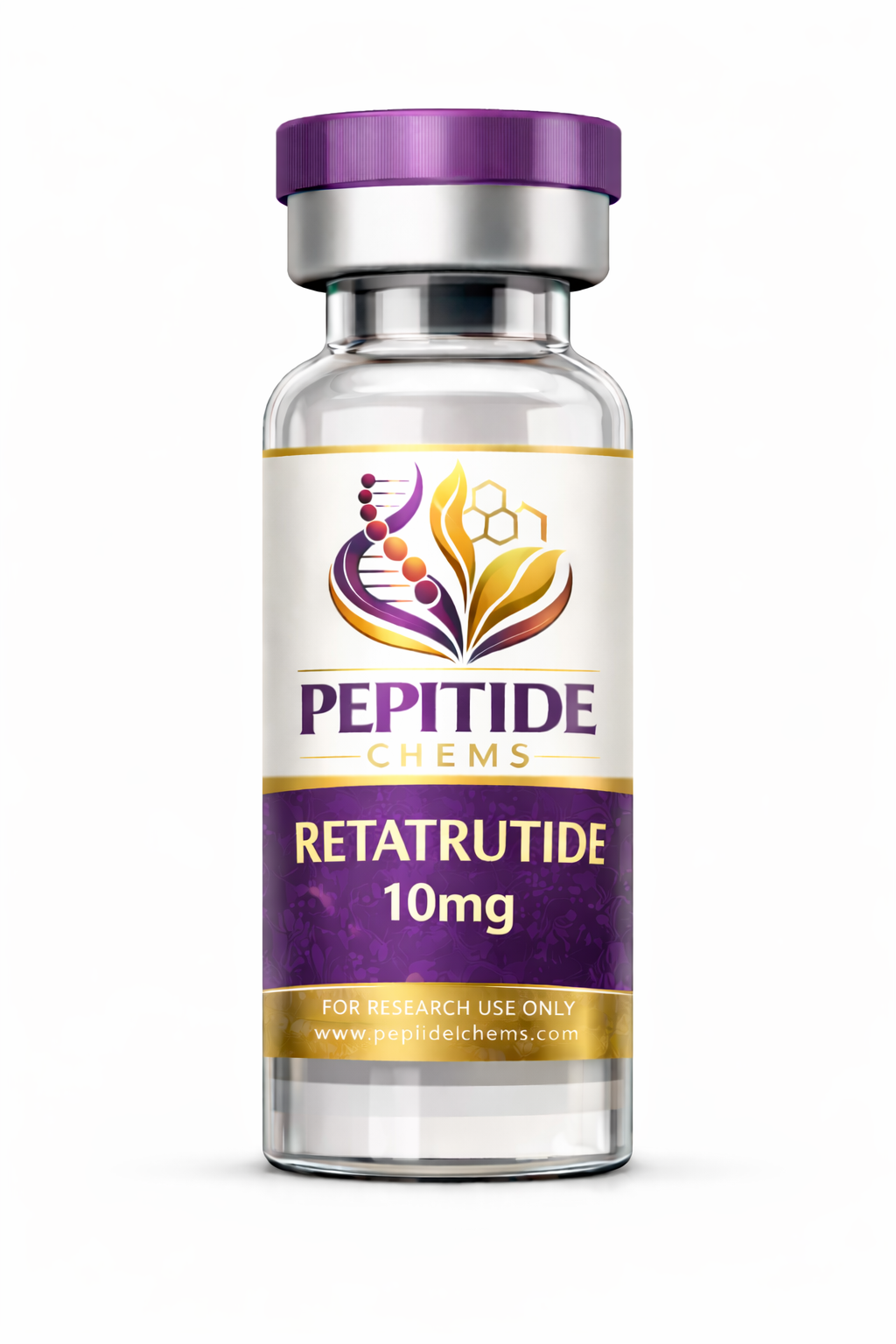
Retatrutide
Triple receptor agonist under investigation in metabolic research.
Research Areas
Scientific Background
Retatrutide is a triple receptor agonist being studied for its interactions with GLP-1, GIP, and glucagon receptors. It is the subject of ongoing clinical trials examining metabolic pathways.
Deep Dive: How It Works
Retatrutide's triple agonism creates a synergistic metabolic effect: (1) GLP-1 activation suppresses appetite, slows gastric emptying, and enhances insulin secretion; (2) GIP activation potentiates glucose-dependent insulin release and may improve fat tissue metabolism; (3) Glucagon activation stimulates hepatic fat oxidation and thermogenesis, directly mobilizing stored energy. The glucagon component is what distinguishes Retatrutide from dual agonists like tirzepatide — it adds a direct fat-burning pathway rather than relying solely on appetite reduction. This triple mechanism also improves liver fat clearance, relevant for metabolic dysfunction-associated steatotic liver disease (MASLD).
Key Insight
Retatrutide's glucagon receptor component is the breakthrough — previous drugs avoided glucagon because it raises blood sugar. But when combined with GLP-1 and GIP (which lower blood sugar), the glucagon-mediated fat burning occurs without hyperglycemia. It's the balance of all three that creates the synergy.
Optimization & Cofactors
Published research on compounds that support this peptide's mechanisms
Cofactor information is compiled from published nutritional and biochemical research. This is educational content, not supplementation advice. Consult a qualified healthcare provider.
Protein (High Quality)
25-40g per meal, 1.2g/kg/day minimumCritical to prevent muscle loss during rapid weight reduction
Heymsfield et al. (2024) showed lean mass preservation requires adequate protein during GLP-1 RA therapy
Vitamin D3
Morning with fatty mealRapid weight loss depletes fat-soluble vitamin stores
Bariatric research shows D3 deficiency accelerates during rapid fat loss
Electrolytes (Mg/K/Na)
GLP-1 agonists cause nausea/reduced intake leading to electrolyte imbalance
Clinical trial data shows GI symptoms are common — electrolyte balance is essential
Creatine Monohydrate
5g daily with any mealMay help preserve lean mass during caloric deficit
Forbes et al. (2023) meta-analysis supports creatine for lean mass preservation during energy restriction
Compatibility & Stacking Guide
Research on combining peptides based on published mechanisms
Compatibility information is based on published mechanisms of action. No clinical trials have validated most combinations in humans. This is educational content only.
Compatible Compounds (Research-Based)
ERRα activation may counteract GLP-1-associated muscle loss — complementary mechanism
BPC-157 cytoprotective research may address GI tissue stress from GLP-1 activity
Use Separately (Research-Based)
Stacking multiple GLP-1 receptor agonists has no safety data and risks severe GI effects
Timing Guide from Published Research
Phase 2 trial (Jastreboff et al., NEJM 2023) used weekly subcutaneous injections with dose escalation over 24 weeks starting at 0.5mg.
Published Clinical Study Protocols
Data from peer-reviewed publications and registered clinical trials
These protocols are cited from published research for educational purposes only. They do not constitute recommendations. All research must be conducted under appropriate institutional oversight.
TRIUMPH-4 Phase 3 Trial (Obesity + Knee Osteoarthritis)
Eli Lilly, December 2025 (NCT05931367)
Once-weekly subcutaneous injections at 2mg, 4mg, 8mg, or 12mg doses for 68 weeks in adults with obesity/overweight and knee osteoarthritis
12mg dose: average 28.7% body weight loss (71.2 lbs). Knee pain reduction up to 75.8%. 1 in 8 patients completely pain-free at end of trial.
TRANSCEND-T2D-1 Phase 3 Trial (Type 2 Diabetes)
Eli Lilly, March 2026 (NCT06354660)
Once-weekly doses escalated to 12mg over 40 weeks in adults with type 2 diabetes and inadequate glycemic control
A1C reduction up to 2.0%, body weight loss of 16.8% (36.6 lbs). Improvements in systolic blood pressure, triglycerides, and non-HDL cholesterol.
Phase 2 Dose-Ranging Study
Jastreboff et al., New England Journal of Medicine, 2023
48-week study with escalating doses up to 12mg weekly in adults with BMI ≥30 (or ≥27 with comorbidities)
Highest dose group achieved ~24% body weight reduction — the largest recorded in any Phase 2 obesity trial at that time.
Synergy & Cofactor Research
How this compound interacts with other molecules in research
Triple vs. Dual vs. Single Agonism
Retatrutide's glucagon component adds a direct energy expenditure pathway that GLP-1-only (semaglutide) and GLP-1/GIP dual agonists (tirzepatide) lack.
While GLP-1 reduces appetite and GIP potentiates insulin, glucagon receptor activation triggers hepatic fat oxidation and increases basal metabolic rate. This 'three-pronged' approach addresses food intake, metabolic efficiency, AND energy expenditure simultaneously.
Purity & Provenance
Why quality matters for research validity
As an investigational drug in active Phase 3 trials, research-grade Retatrutide requires rigorous quality verification. Independent mass spectrometry and amino acid analysis are essential.
Areas of Investigation
Laboratory Information
Technical specifications for research settings
This compound is intended for qualified scientific research only. Not for human or veterinary use. Not for diagnostic or therapeutic applications. Researchers must comply with all applicable regulations in their jurisdiction.
Store at -20°C. Handle per clinical research protocols.
Lyophilized powder
Research grade
Investigational compound under clinical development.
Deepen Your Research
Published literature and clinical trial registries
Published Literature
Peer-reviewed publications from clinical trials have reported on the pharmacological properties of this compound.
Regulatory Classification
Retatrutide is currently in Phase 3 clinical trials. It is an investigational compound not yet approved for any use.
Important Research Notice
This information is compiled from scientific literature for educational purposes only. This website does not sell, distribute, or recommend any compounds for human use. All compounds discussed are for qualified research purposes only.