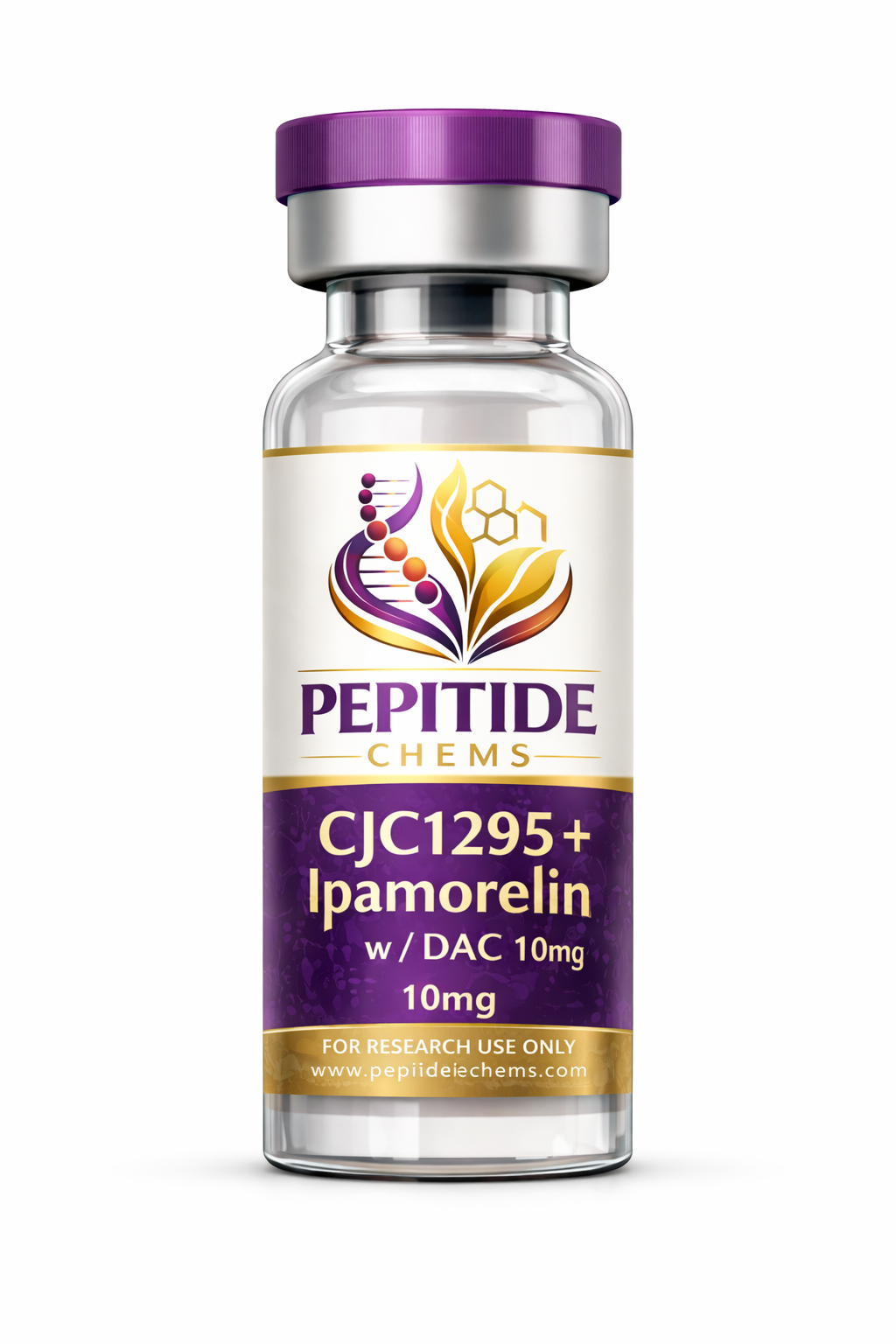
CJC1295+Ipamorelin W/DAC
Peptide combination studied in growth hormone secretion research.
Research Areas
Scientific Background
CJC-1295 is a synthetic analog of growth hormone-releasing hormone (GHRH), while Ipamorelin is a growth hormone secretagogue. Scientific literature has examined their mechanisms in stimulating growth hormone release from the pituitary gland.
Deep Dive: How It Works
The 'dual-signal' concept leverages two complementary pathways: CJC-1295 binds GHRH receptors on pituitary somatotrophs, providing a sustained background signal that primes GH synthesis and storage. Ipamorelin activates ghrelin receptors (GHS-R1a), triggering acute GH release pulses from these pre-loaded somatotrophs. The DAC modification in CJC-1295 creates a covalent bond with albumin, increasing half-life from ~30 minutes to ~6-8 days. This combination mimics the natural dual-input control of GH secretion — the body normally uses both GHRH and ghrelin to regulate pulsatile GH release.
Key Insight
Ipamorelin's selectivity is what sets it apart — older GH secretagogues like GHRP-6 and Hexarelin would also elevate cortisol (stress hormone) and prolactin, creating unwanted side effects. Ipamorelin specifically targets GH release while leaving other hormonal axes undisturbed.
Optimization & Cofactors
Published research on compounds that support this peptide's mechanisms
Cofactor information is compiled from published nutritional and biochemical research. This is educational content, not supplementation advice. Consult a qualified healthcare provider.
Glycine
3g before bedSupports GH release during sleep — enhances sleep quality and nocturnal GH pulsatility
Bannai et al. (2012) demonstrated glycine improves sleep quality and may enhance sleep-associated GH release
Zinc
25-30mg with lunchEssential mineral for GH-IGF-1 axis function
Prasad (2013) showed zinc is required for proper GH synthesis and secretion
Vitamin D3
Morning with fatty mealVitamin D receptors in pituitary gland influence GH production
Ameri et al. (2013) found correlation between vitamin D levels and IGF-1 production
Magnesium
Glycinate form, 200-400mg before bedSupports deep sleep phases where GH is maximally released
Abbasi et al. (2012) showed magnesium supplementation improves sleep quality markers
Compatibility & Stacking Guide
Research on combining peptides based on published mechanisms
Compatibility information is based on published mechanisms of action. No clinical trials have validated most combinations in humans. This is educational content only.
Compatible Compounds (Research-Based)
Both target GH axis through GHRH pathway — Tesamorelin is FDA-approved version
GH supports systemic recovery while BPC-157 targets local tissue repair
GH enhances systemic regeneration while GHK-Cu targets skin/tissue remodeling
Use Separately (Research-Based)
Exogenous GH suppresses endogenous GH secretion via negative feedback
Timing Guide from Published Research
Clinical research protocols administer GHRH analogs before sleep or morning fasted state. Food intake (carbs/fats) blunts GH response. Published protocols suggest 30-60min separation from meals.
Published Clinical Study Protocols
Data from peer-reviewed publications and registered clinical trials
These protocols are cited from published research for educational purposes only. They do not constitute recommendations. All research must be conducted under appropriate institutional oversight.
Prolonged GH Stimulation with CJC-1295
Teichman et al., Journal of Clinical Endocrinology & Metabolism, 2006
Doses of 30, 60, or 125 µg/kg administered subcutaneously in healthy adults aged 21-61
Mean GH levels increased 2-10x for 6+ days; IGF-1 elevated 1.5-3x for 14+ days with sustained dose-dependent response
Ipamorelin Selectivity Profile
Raun et al., European Journal of Endocrinology, 1998
Various doses administered in preclinical models to compare GH, ACTH, cortisol, and prolactin responses
Ipamorelin stimulated GH release comparable to GHRP-6 but without significant cortisol or prolactin elevation
Synergy & Cofactor Research
How this compound interacts with other molecules in research
Dual Receptor Activation
The combination targets both GHRH and ghrelin pathways simultaneously, which mirrors the body's natural GH regulation system.
CJC-1295 primes somatotrophs for GH synthesis while Ipamorelin triggers release. Together, they produce more robust GH pulses than either compound alone — similar to how the hypothalamus uses both GHRH and ghrelin to regulate GH secretion.
Sleep & GH Optimization
GH secretion is naturally highest during slow-wave (deep) sleep. Research suggests GHRH activity may enhance slow-wave sleep duration.
GHRH receptor activation is associated with enhanced slow-wave sleep, which is itself the primary period for natural GH secretion. This creates a positive feedback loop between GHRH activity and GH release.
Purity & Provenance
Why quality matters for research validity
Research-grade CJC-1295 should show ≥98% purity via HPLC with mass spectrometry confirmation. The DAC component extends half-life from ~30min to ~8 days — impurities may interfere with albumin binding. Always verify COA from independent lab.
Areas of Investigation
Laboratory Information
Technical specifications for research settings
This compound is intended for qualified scientific research only. Not for human or veterinary use. Not for diagnostic or therapeutic applications. Researchers must comply with all applicable regulations in their jurisdiction.
Store at -20°C. Reconstituted solutions should be stored at 2-8°C.
Lyophilized powder blend
>97% by HPLC
Soluble in bacteriostatic water for research preparation
For in vitro and qualified research applications only.
Deepen Your Research
Published literature and clinical trial registries
Published Literature
Published research has explored the pharmacokinetics and mechanisms of these peptides in laboratory settings.
Regulatory Classification
These peptides are investigational compounds. Not available for compounding under current FDA regulations. For qualified research purposes only.
Important Research Notice
This information is compiled from scientific literature for educational purposes only. This website does not sell, distribute, or recommend any compounds for human use. All compounds discussed are for qualified research purposes only.