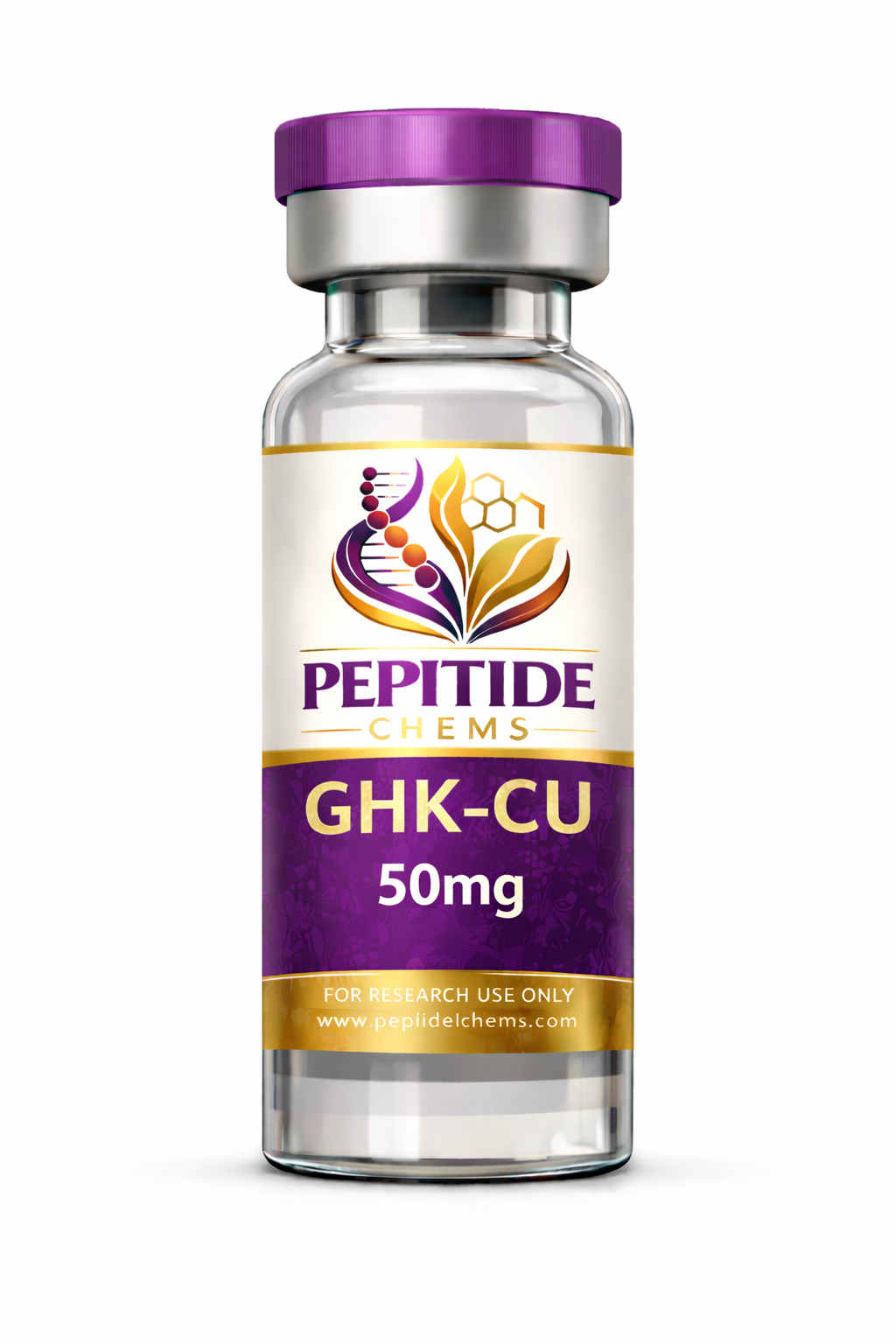
GHK-CU
Copper peptide complex studied in tissue regeneration research.
Research Areas
Scientific Background
GHK-Cu (Glycyl-L-histidyl-L-lysine copper complex) is a naturally occurring tripeptide-copper complex. Scientific literature has explored its role in gene expression related to tissue remodeling.
Deep Dive: How It Works
GHK-Cu operates through multiple parallel mechanisms: (1) TISSUE REPAIR: Upregulates collagen types I, III, and V, plus elastin and decorin synthesis, directly rebuilding the dermal matrix; (2) ANTI-INFLAMMATORY: Suppresses pro-inflammatory cytokines IL-1β, TNF-α, and IL-6 while activating anti-inflammatory pathways, reducing chronic inflammation that drives tissue degradation; (3) ANGIOGENESIS: Promotes formation of new blood vessels through VEGF-related pathways, ensuring nutrient delivery to healing tissue; (4) STEM CELL RECRUITMENT: Evidence suggests GHK-Cu attracts stem cells to wound sites and promotes their differentiation into tissue-specific cells; (5) ANTIOXIDANT: The copper component participates in superoxide dismutase (SOD) activity, reducing oxidative damage. Unlike most peptides that target a single pathway, GHK-Cu's broad gene expression modulation gives it multi-target effects from a single molecule.
Key Insight
GHK-Cu is one of the few peptides that is both naturally occurring AND has extensive gene expression data supporting its effects. It's already present in your body — levels just decline with age. This makes its mechanism well-characterized compared to most synthetic peptides.
Optimization & Cofactors
Published research on compounds that support this peptide's mechanisms
Cofactor information is compiled from published nutritional and biochemical research. This is educational content, not supplementation advice. Consult a qualified healthcare provider.
Vitamin C (Ascorbic Acid)
500-1000mg divided doses dailyEssential for collagen synthesis — GHK-Cu stimulates collagen but vitamin C is required for procollagen hydroxylation
Pullar et al. (2017, Nutrients) confirmed vitamin C is rate-limiting for collagen biosynthesis
Zinc (25-30mg)
25mg with lunch (away from copper compounds)Required for 300+ enzymes including MMPs that GHK-Cu regulates. Prevents copper-zinc imbalance.
Maintain ~10:1 zinc-to-copper ratio. Journal of Trace Elements (2019).
Vitamin D3
Morning with fatty mealSynergistic with GHK-Cu in wound healing — vitamin D enhances antimicrobial peptide production
Sadat-Ali et al. (2018) noted D deficiency impairs wound healing
Glycine
3-5g before bedPrimary amino acid in collagen (every 3rd position). GHK-Cu upregulation of collagen increases glycine demand.
Most abundant amino acid in collagen. Also improves sleep quality (Bannai et al.).
Vitamin B Complex
Morning with foodB vitamins support methylation and gene expression programs activated by GHK-Cu
GHK-Cu modulates 4,000+ genes — B vitamins are cofactors in methylation reactions
Compatibility & Stacking Guide
Research on combining peptides based on published mechanisms
Compatibility information is based on published mechanisms of action. No clinical trials have validated most combinations in humans. This is educational content only.
Compatible Compounds (Research-Based)
GHK-Cu promotes tissue remodeling while BPC-157 promotes angiogenesis — complementary repair
TB-500 enhances cell migration; GHK-Cu activates gene programs — sequential repair
NAD+-dependent sirtuins support the same anti-aging programs GHK-Cu activates
GHK-Cu stimulates mitochondrial genes; SS-31 optimizes membrane integrity
Timing Guide from Published Research
Topical studies apply morning and evening. Subcutaneous research protocols are typically once daily. Vitamin C and glycine daily. Zinc at different time than copper compounds to avoid competitive absorption.
Published Clinical Study Protocols
Data from peer-reviewed publications and registered clinical trials
These protocols are cited from published research for educational purposes only. They do not constitute recommendations. All research must be conducted under appropriate institutional oversight.
Post-Laser Resurfacing Recovery
Grand Ingredients, Multicenter Study, 2024
0.05% GHK-Cu gel applied topically after fractional laser resurfacing, assessed at 24, 48, and 72 hours post-procedure
25% faster epithelial recovery, significant reduction in erythema (redness) within 72 hours compared to standard care.
Gene Expression Profiling
Pickart et al., BioMed Research International, 2015
Genome-wide analysis of GHK-Cu effects on human gene expression using the Broad Institute's Connectivity Map data
4,000+ genes modulated: collagen, elastin, and tissue repair genes upregulated; inflammatory and metastasis-related genes downregulated.
Synergy & Cofactor Research
How this compound interacts with other molecules in research
GHK-Cu + Retinoids
While retinoids (tretinoin/retinol) stimulate cell turnover and collagen via retinoic acid receptors, GHK-Cu works through entirely different pathways (copper-dependent gene expression), making them complementary rather than redundant.
Retinoids increase cell turnover and stimulate collagen via RAR/RXR receptors. GHK-Cu upregulates collagen and ECM proteins via copper-mediated gene expression. Different pathways = additive effects.
GHK-Cu + Vitamin C
Vitamin C is essential for collagen cross-linking — the final step in collagen maturation. GHK-Cu stimulates collagen PRODUCTION, but without adequate vitamin C, new collagen strands cannot form stable triple-helix structures.
GHK-Cu triggers fibroblasts to produce procollagen. Vitamin C (as a cofactor for prolyl and lysyl hydroxylases) is required for hydroxylation of proline residues, enabling collagen cross-linking and structural stability.
Purity & Provenance
Why quality matters for research validity
GHK-Cu quality depends on proper copper chelation. Free copper is cytotoxic; the GHK-Cu complex is protective. Verify peptide purity (≥98% HPLC) AND copper stoichiometry (1:1 ratio). Provenance from GMP-certified facilities recommended.
Areas of Investigation
Laboratory Information
Technical specifications for research settings
This compound is intended for qualified scientific research only. Not for human or veterinary use. Not for diagnostic or therapeutic applications. Researchers must comply with all applicable regulations in their jurisdiction.
Store at -20°C. Protect from light and moisture.
Lyophilized powder
>98% by HPLC
Soluble in water
For in vitro research and cosmetic formulation studies.
Deepen Your Research
Published literature and clinical trial registries
Published Literature
Peer-reviewed studies have examined GHK-Cu's molecular interactions in laboratory and cosmetic research contexts.
Regulatory Classification
GHK-Cu is a research compound. Cosmetic applications may have different regulatory considerations.
Important Research Notice
This information is compiled from scientific literature for educational purposes only. This website does not sell, distribute, or recommend any compounds for human use. All compounds discussed are for qualified research purposes only.