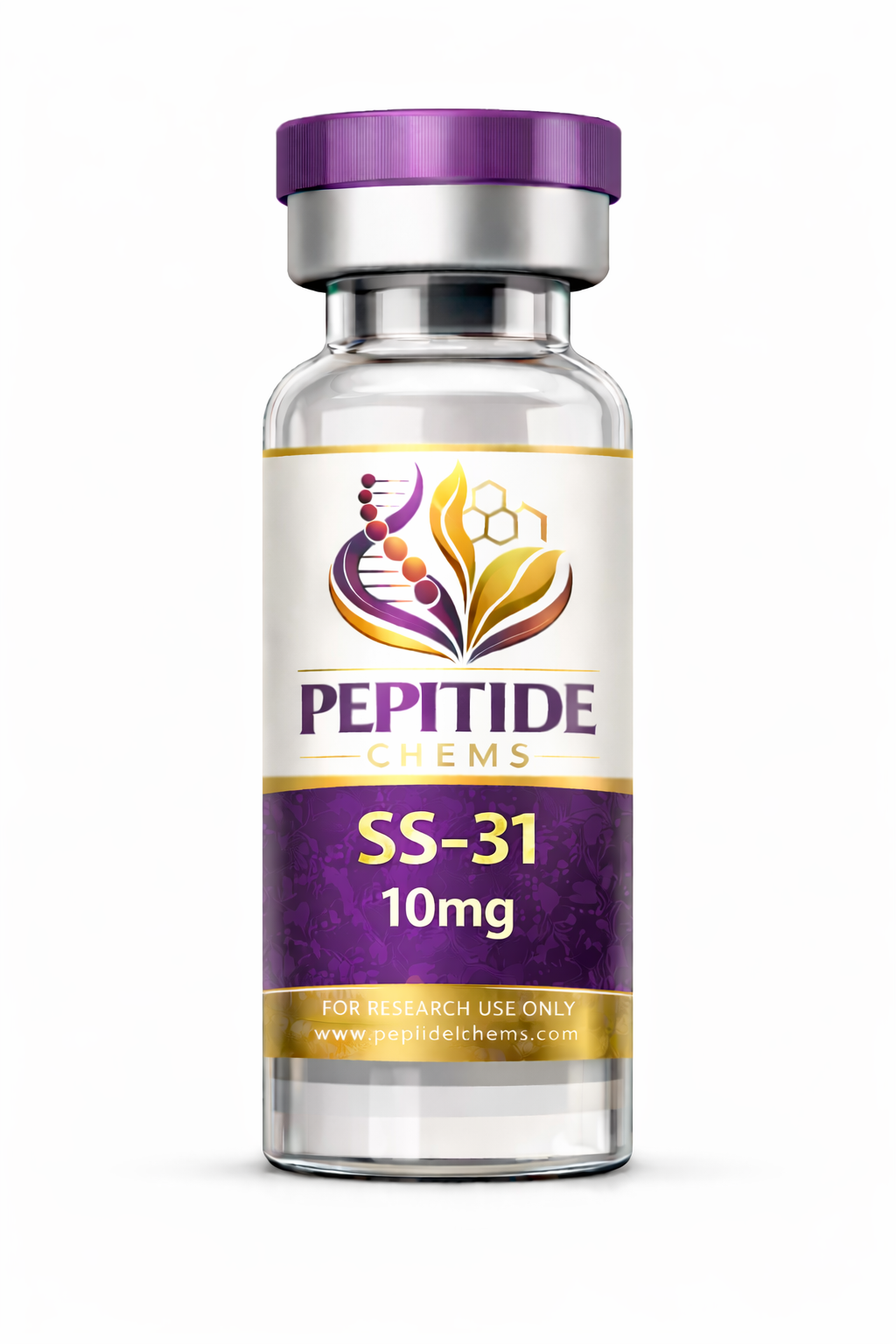
SS-31
Mitochondria-targeted peptide studied in cellular energy research.
Research Areas
Scientific Background
SS-31 (Elamipretide) is a mitochondria-targeted peptide that has been studied for its interactions with cardiolipin in the inner mitochondrial membrane.
Deep Dive: How It Works
SS-31's mechanism is fundamentally different from antioxidants: it acts STRUCTURALLY rather than chemically. Cardiolipin is a unique phospholipid in the inner mitochondrial membrane that anchors ETC Complexes I, III, and IV into supercomplexes called 'respirasomes.' When cardiolipin oxidizes (which increases with age and disease), these supercomplexes disassemble, causing electron 'leakage' that generates ROS. SS-31 binds to cardiolipin, stabilizing its structure and preventing oxidation, which keeps respirasomes intact. This means electrons flow efficiently through the chain without 'leaking' — reducing ROS at the source rather than scavenging it after the fact. CRITICAL: SS-31 only provides the structural framework. Without adequate electron carriers (CoQ10/ubiquinol for Complex I→III shuttle) and NAD+ (the primary electron donor at Complex I), a stabilized membrane has nothing to transport efficiently. Think of SS-31 as repairing the highway — but you still need cars (electrons from NAD+) and fuel stations (CoQ10) for traffic to flow.
Key Insight
SS-31 is the 'highway repair crew' of mitochondrial biology — it fixes the infrastructure (cardiolipin/membrane) but doesn't provide traffic (electrons) or fuel (NAD+/CoQ10). Without these cofactors, SS-31 stabilizes an empty road. This is why researchers emphasize that mitochondrial health requires a systems approach, not a single intervention.
Optimization & Cofactors
Published research on compounds that support this peptide's mechanisms
Cofactor information is compiled from published nutritional and biochemical research. This is educational content, not supplementation advice. Consult a qualified healthcare provider.
CoQ10 (Ubiquinol)
100-200mg with fatty meal (morning)Critical electron carrier in Complex III — SS-31 stabilizes the membrane but CoQ10 carries the electrons
Szeto (2014) emphasized membrane stabilization and electron transport are co-dependent
NAD+ Precursors (NMN/NR)
Morning administrationNAD+ donates electrons at Complex I — SS-31 stabilizes the receiving end
NAD+ = fuel input, SS-31 = infrastructure maintenance. Aging Cell (2020).
Alpha-Lipoic Acid (ALA)
600mg morning, fastedMitochondrial antioxidant complementing SS-31 membrane-specific action
Shay et al. (2009, BBA) reviewed ALA as mitochondrial cofactor
PQQ (Pyrroloquinoline Quinone)
10-20mg morningPromotes mitochondrial biogenesis while SS-31 optimizes existing ones
Chowanadisai et al. (2010) showed PQQ activates PGC-1α for mitochondrial biogenesis
Compatibility & Stacking Guide
Research on combining peptides based on published mechanisms
Compatibility information is based on published mechanisms of action. No clinical trials have validated most combinations in humans. This is educational content only.
Compatible Compounds (Research-Based)
SS-31 fixes the road (membrane), NAD+ provides fuel (electrons)
GHK-Cu activates mitochondrial gene expression; SS-31 targets membrane structure
ERRα creates new mitochondria; SS-31 maintains existing ones — quantity + quality
Timing Guide from Published Research
FDA-approved Elamipretide is administered as daily subcutaneous injection. CoQ10/NAD+ cofactors should be established concurrent with mitochondrial membrane interventions.
Published Clinical Study Protocols
Data from peer-reviewed publications and registered clinical trials
These protocols are cited from published research for educational purposes only. They do not constitute recommendations. All research must be conducted under appropriate institutional oversight.
TAZPOWER Trial (Barth Syndrome)
FDA Accelerated Approval, September 2025 (NDA 215244)
Subcutaneous injections in patients aged 12+ with Barth syndrome weighing ≥30kg, assessed over 168 weeks
Sustained improvements in knee extensor muscle strength. Led to FDA accelerated approval as Forzinity for Barth syndrome.
PROGRESS-HF (Heart Failure)
ClinicalTrials.gov: NCT03323749
Subcutaneous administration in patients with heart failure and reduced ejection fraction (HFrEF)
Assessed changes in left ventricular end-systolic volume. Safety profile consistent with previous trials.
Synergy & Cofactor Research
How this compound interacts with other molecules in research
SS-31 + NAD+ Precursors (NMN/NR)
SS-31 stabilizes the mitochondrial membrane, but NAD+ is the primary electron donor at Complex I. Without NAD+, a stabilized membrane has nothing to transport. This is the 'fuel' problem — the peptide without NAD+ is like a repaired highway with no cars.
Research suggests administering NAD+ precursors 60-90 minutes AFTER SS-31 to allow membrane stabilization before increasing electron flux. Premature electron surge through an unstabilized membrane could increase ROS.
SS-31 + CoQ10 (Ubiquinol)
CoQ10 is the mobile electron carrier between Complexes I/II and III. Stabilized respirasomes (from SS-31) still need CoQ10 as the 'shuttle bus' for electrons.
CoQ10 takes hours to reach peak plasma levels and distribute to mitochondria. Research suggests 'front-loading' CoQ10 4-6 hours BEFORE SS-31 so the ubiquinol pool is saturated when the membrane stabilizes.
SS-31 + Mitochondrial-Derived Peptides (MOTS-c/Humanin)
These peptides activate AMPK and inhibit BAX respectively, complementing SS-31's structural role without competing for the same binding sites.
MOTS-c activates AMPK (metabolic regulation), Humanin inhibits BAX (anti-apoptotic), SS-31 stabilizes membranes. Three different pathways, no competition.
Purity & Provenance
Why quality matters for research validity
SS-31 (D-Arg-Dmt-Lys-Phe-NH2) contains non-natural amino acid 2,6-dimethyltyrosine. Impurities can produce inactive stereoisomers. HPLC ≥98% and mass spec (640.8 Da) essential.
Areas of Investigation
Laboratory Information
Technical specifications for research settings
This compound is intended for qualified scientific research only. Not for human or veterinary use. Not for diagnostic or therapeutic applications. Researchers must comply with all applicable regulations in their jurisdiction.
Store at -20°C. Protect from light.
Lyophilized powder
>95% by HPLC
Soluble in water
For mitochondrial research applications.
Deepen Your Research
Published literature and clinical trial registries
Published Literature
Clinical trials are ongoing for SS-31 in specific mitochondrial conditions. Published research has examined its molecular mechanisms.
Regulatory Classification
SS-31 (Elamipretide) is in clinical trials for specific conditions. It remains an investigational compound.
Important Research Notice
This information is compiled from scientific literature for educational purposes only. This website does not sell, distribute, or recommend any compounds for human use. All compounds discussed are for qualified research purposes only.