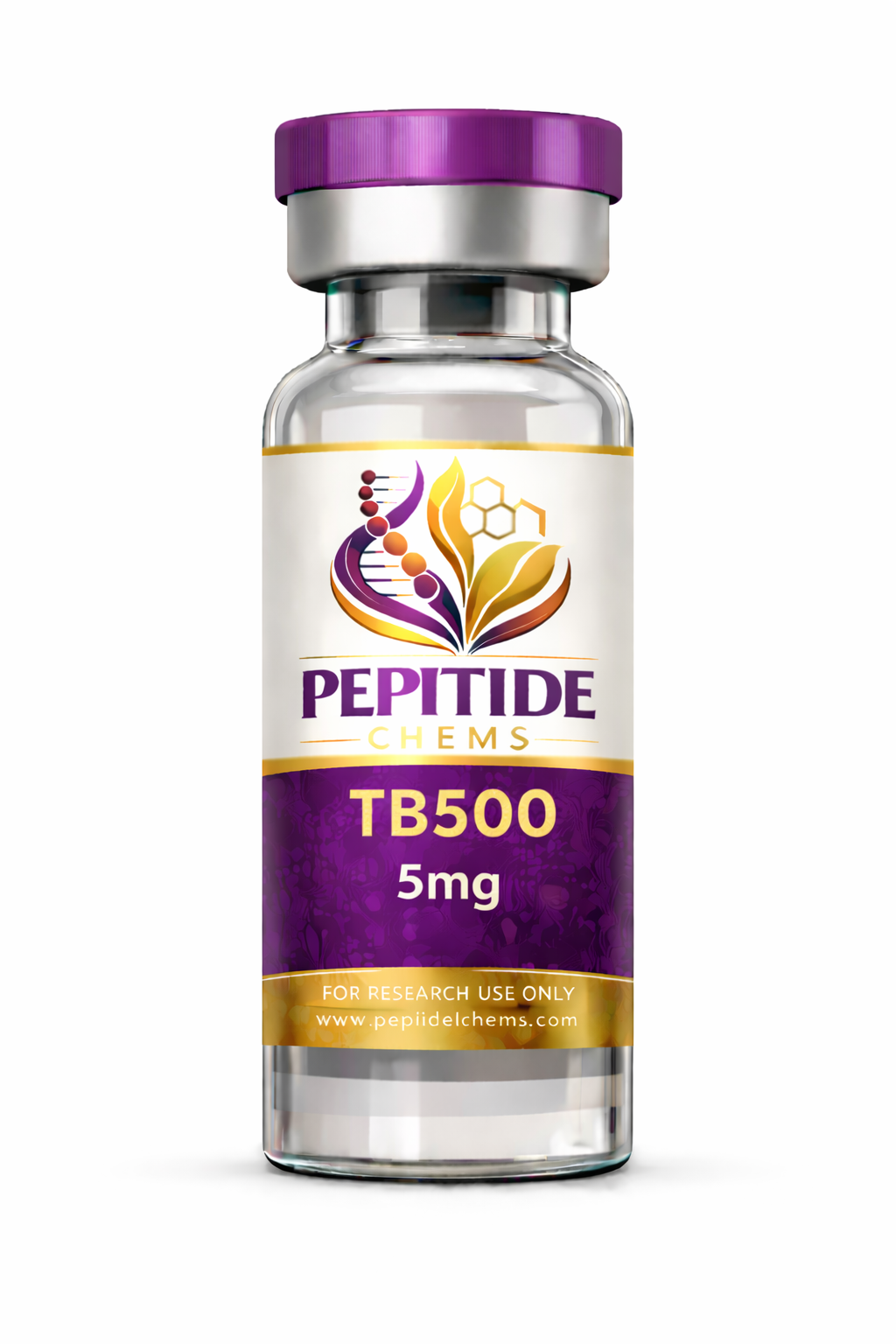
TB500
Thymosin Beta-4 fragment studied in cell migration research.
Research Areas
Scientific Background
TB-500 is a synthetic form of Thymosin Beta-4, a protein involved in cell motility and differentiation. Scientific literature has examined its role in actin polymerization and cellular migration.
Deep Dive: How It Works
TB-500's mechanism centers on the cytoskeleton: (1) ACTIN SEQUESTRATION: TB-500 binds monomeric G-actin, preventing premature polymerization into F-actin filaments. This maintains a pool of 'ready' actin monomers that can be rapidly deployed when a cell needs to change shape and move; (2) CELL MIGRATION: By regulating the actin pool, TB-500 enables cells (fibroblasts, keratinocytes, endothelial cells) to rapidly reorganize their cytoskeleton for directional migration toward injury sites; (3) ANGIOGENESIS: Endothelial cell migration and tube formation are actin-dependent processes. TB-500's effect on endothelial cell motility may facilitate new blood vessel formation; (4) ANTI-INFLAMMATORY: Research indicates suppression of NF-κB-mediated inflammatory signaling, reducing tissue-damaging inflammation at injury sites. Unlike BPC-157 (which 'prepares' the repair site via vascular/growth factor pathways), TB-500 'enables' cells to physically travel to where repair is needed.
Key Insight
Think of TB-500 as the 'logistics coordinator' — it doesn't build the repair site (that's BPC-157's vascular/growth factor role) and it doesn't provide energy (that's NAD+'s role). Instead, it ensures the repair CELLS can physically GET to where they're needed by managing their internal transport system (actin cytoskeleton).
Optimization & Cofactors
Published research on compounds that support this peptide's mechanisms
Cofactor information is compiled from published nutritional and biochemical research. This is educational content, not supplementation advice. Consult a qualified healthcare provider.
Vitamin C
500-1000mg dailySupports collagen in tissue repair activated by TB-500 cell migration
Cell migration requires extracellular matrix support dependent on vitamin C
Zinc
25mg with mealsEssential for cell division and immune function TB-500 coordinates
Cell migration/proliferation are zinc-dependent (Haase & Rink, 2014)
Omega-3 Fatty Acids
2-3g EPA/DHA with mealsAnti-inflammatory support complementing TB-500 repair-phase activity
Resolution of inflammation prerequisite for repair phase (Serhan et al., 2008)
Compatibility & Stacking Guide
Research on combining peptides based on published mechanisms
Compatibility information is based on published mechanisms of action. No clinical trials have validated most combinations in humans. This is educational content only.
Compatible Compounds (Research-Based)
Prepare & Migrate combo — BPC-157 builds blood supply, TB-500 directs repair cells to site
TB-500 gets cells to repair site; GHK-Cu activates gene programs they need
Pre-combined Wolverine Stack formulation
Timing Guide from Published Research
Preclinical studies use loading and maintenance phases. Published rodent protocols: 2x/week during active repair, then reduced frequency. BPC-157 + TB-500 is most-cited pairing.
Published Clinical Study Protocols
Data from peer-reviewed publications and registered clinical trials
These protocols are cited from published research for educational purposes only. They do not constitute recommendations. All research must be conducted under appropriate institutional oversight.
Cardiac Progenitor Cell Activation (Preclinical)
Smart et al., Nature, 2007
Thymosin Beta-4 administered in murine cardiac injury models to assess epicardial progenitor cell response
Tβ4 reactivated epicardial progenitor cells and promoted formation of new cardiomyocytes post-injury.
Dermal Wound Healing (Preclinical)
Philp et al., Expert Opinion on Biological Therapy, 2004
Topical and systemic administration of Tβ4 in full-thickness rodent wound models
Accelerated wound closure, increased keratinocyte migration, enhanced angiogenesis, and reduced inflammatory cell infiltration.
Synergy & Cofactor Research
How this compound interacts with other molecules in research
TB-500 + BPC-157 ('Prepare & Migrate')
BPC-157 stabilizes the vascular environment and upregulates growth factors (VEGF, EGF, HGF), while TB-500 enables cellular migration through actin regulation. Different pathways, complementary actions.
BPC-157 'prepares the site' by creating blood supply and repair signals. TB-500 'sends the workers' by enabling cells to physically migrate to the prepared area. Neither pathway competes with or interferes with the other.
Purity & Provenance
Why quality matters for research validity
TB-500 is a synthetic fragment of Thymosin Beta-4 (aa 17-23). Mass spec verification of active sequence required. HPLC ≥98%. Removed from FDA Category 2 in April 2026.
Areas of Investigation
Laboratory Information
Technical specifications for research settings
This compound is intended for qualified scientific research only. Not for human or veterinary use. Not for diagnostic or therapeutic applications. Researchers must comply with all applicable regulations in their jurisdiction.
Store at -20°C. Protect from light.
Lyophilized powder
>97% by HPLC
Soluble in water
For in vitro cell biology research applications only.
Deepen Your Research
Published literature and clinical trial registries
Published Literature
Published laboratory studies have examined TB-500's molecular mechanisms related to cytoskeletal function.
Regulatory Classification
TB-500 is an investigational compound. The FDA has classified it as not available for compounding. For qualified research purposes only.
Important Research Notice
This information is compiled from scientific literature for educational purposes only. This website does not sell, distribute, or recommend any compounds for human use. All compounds discussed are for qualified research purposes only.